A footprint per product, and the French environmental cost computed with Ecobalyse.
Total impact in kg CO2e and the French environmental cost in points, computed on the individual product from the chain you collected. Every figure declares how much comes from your suppliers' documents and how much from industry averages.
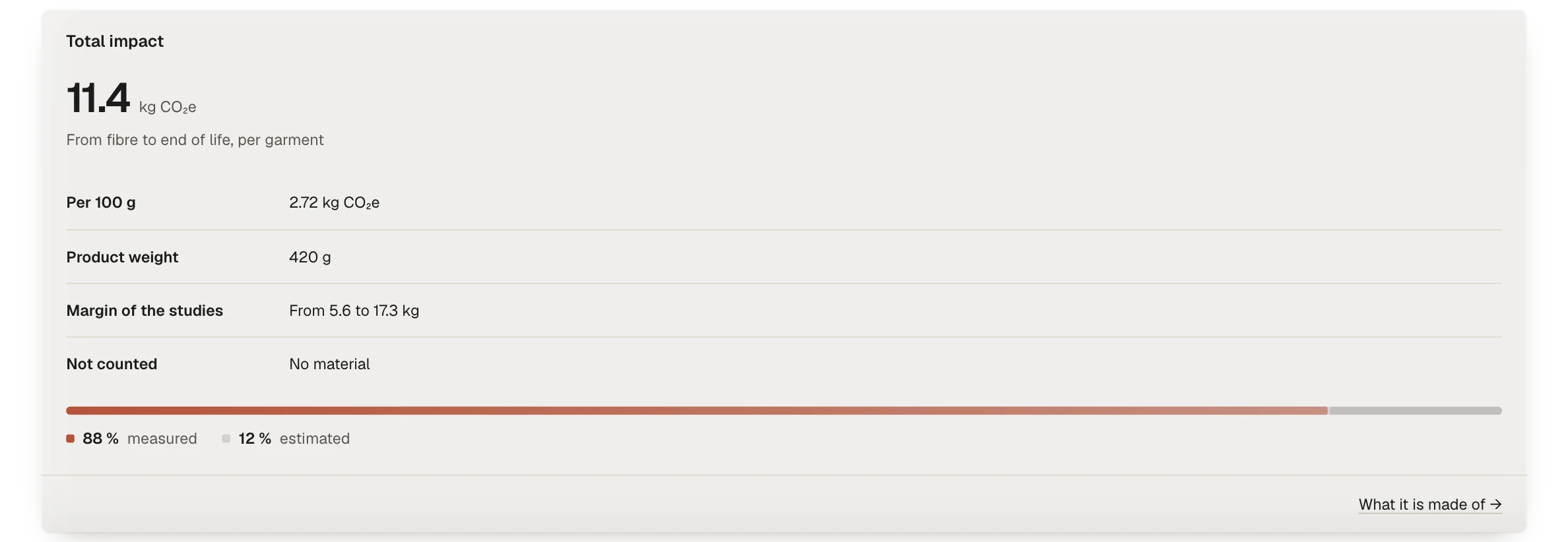
The figure states its own weight
Beside every indicator sits the share that comes from supplier documents. An impact built 19% on real data is not presented as one built 95%.
Every factor cites its source
Ecobalyse, the Joint Research Centre, RISE, ADEME, Our World in Data. Sources are listed on the screen and in the report, with the factor version used for the calculation.
The French environmental cost is the French government's official method
Useful for preparing for the French scheme and for comparing your own products.
What the Impact tab shows for each product
For every garment you see the climate impact in kg CO2e (kilograms of CO2 equivalent, the common unit for climate impact), from the fibre to end of life, and the same figure per 100 grams, so that garments of different weights compare on equal terms. Beside the total sits the range the published studies give for the same materials, so anyone reading the figure, inside your company or outside it, knows at once how to place it.
The total is broken down into six stages: raw material, spinning, dyeing, making up, transport and end of life. You see at a glance where the impact sits and where it pays to act, whether on a fibre, a supplier or a transport leg. Each stage shows whether its value comes from one of your suppliers’ documents or from public reference data, so you know which document to request to replace an industry average with a figure of your own.
Beside it sits the French environmental cost, in impact points, computed with the official method: it is returned by Ecobalyse, the French State’s own calculator, from the supply-chain data you have already collected for the passport, with nothing copied by hand into the calculator product by product. Tramaproof updates it every night and shows, for each garment, the date of the calculation and the version of the method, so you always work on a current figure and can show where it comes from. The more of your supply chain you document, the less your figure depends on the method’s default values, which are conservative and therefore unfavourable.
From the same data Tramaproof prepares the file the French portal asks for, one row per GTIN (the product's barcode number), and the product sheet that French law requires. Once the cost is deposited, the passport of a garment sold in France carries it with the official mark and a link to the product’s page on the State portal. One dataset covers the European passport and the French obligations, and your suppliers answer once.
What it is for
Find the stage worth working on
The breakdown by stage shows where the kilograms sit. In the example above, raw material carries 88% of the total: the fibre and its origin matter far more than the last transport leg.
Know which part you can prove
The measured share tells you which stages still rest on reference data, and so which supplier document would turn an estimate into a measurement. An environmental figure becomes a list of documents to request.
Prepare for the French scheme
Since 1 October 2025 a brand selling in France may display the environmental cost, and from 1 October 2026 a third party may compute and publish it without asking. The Impact tab shows the figure the State’s calculator gives today, and how many of its inputs rest on your data.
Frequently asked questions
Which indicators does Tramaproof calculate?
Two. The climate impact in kg CO2e, computed by Tramaproof’s own engine, and the French environmental cost in points, returned by the Ecobalyse calculator. Tramaproof does not calculate separate indicators for water or energy.
Does Tramaproof give my product a sustainability score?
No. Tramaproof shows figures with their method and their sources. Since 27 September 2026 a sustainability label that is neither certified nor set by a public authority is an unfair commercial practice in the EU, and the European footprint rules for apparel and footwear (PEFCR, version 3.1) do not allow a single score to be shown to consumers.
Where do the reference figures come from?
From published sources: Ecobalyse, the Joint Research Centre, RISE, ADEME and Our World in Data. Each factor names its source, and the report states the version of the factor set used, so every figure can be traced back and reproduced.
Why does the figure change when a supplier sends a document?
Because a measured value replaces a reference value. A supplier’s documented energy use for its stage, once a person has confirmed it, replaces the average for that stage, and the measured share rises with it.
Does the environmental cost appear on the public passport?
Yes, for garments sold in France whose cost has been deposited on the State portal. The passport carries it in impact points, with the official mark and a link to the product’s page on the portal. For every other garment the passport carries what the European regulation asks for.