A customer has asked you for data. Here is what they are actually asking.
If a brand you work with has sent you an email, this page explains what it asks for, how much of your time it takes and what you will not be asked. You do not need to register anywhere to read it or to answer.
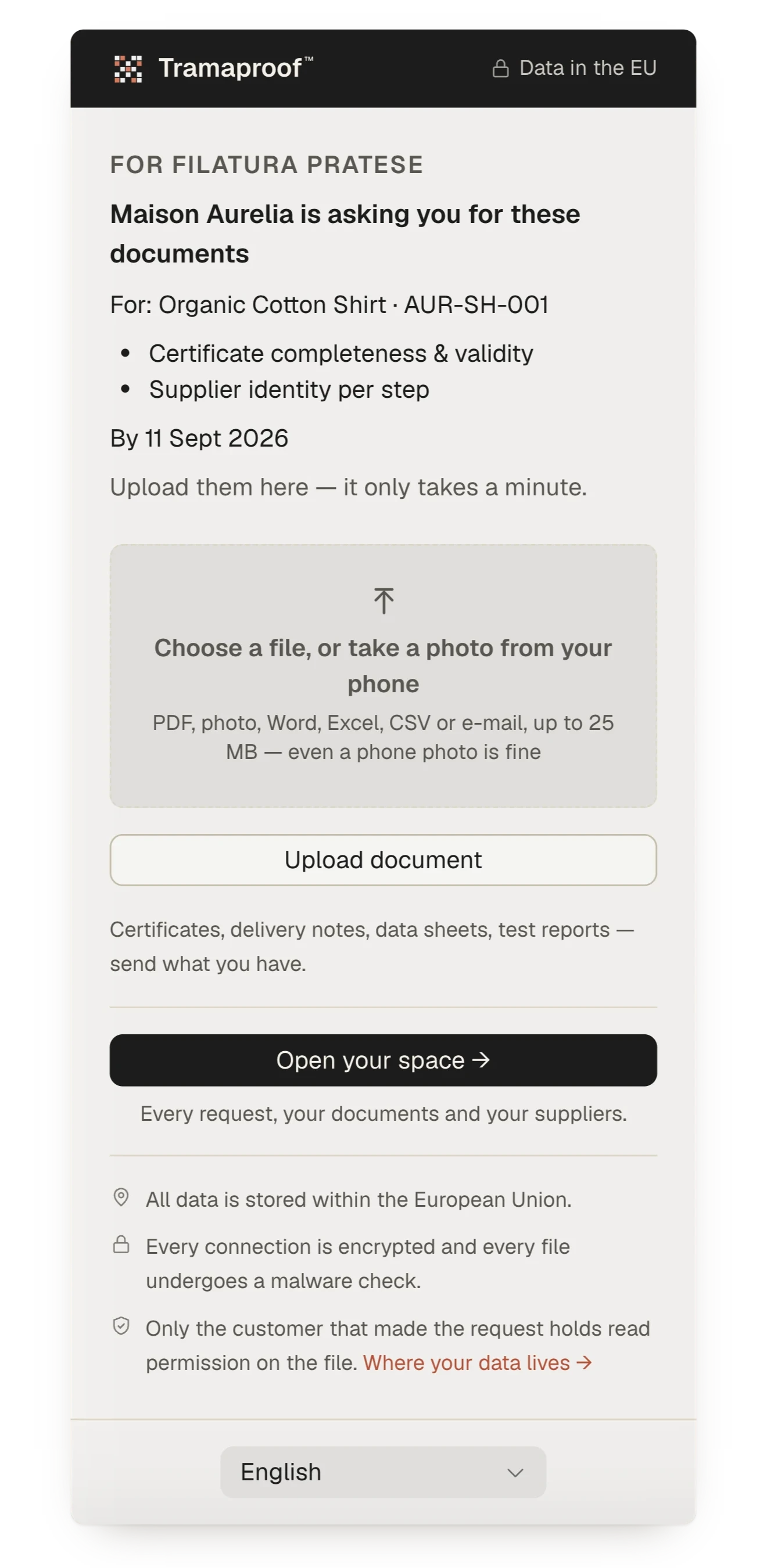
Nothing, and no account
No licence, no password, nothing to install. You open the link in the email, answer one thing at a time, and send. If you do not finish, you pick up from the same point.
Your prices are not asked for
Requests are about what the product is and where it comes from: composition, origin, processes, certificates. Commercial terms do not go into a passport and are not asked of you.
You can name them, in your own name
If a value is not yours but your own supplier's, you name them and the invitation goes out in your name. Your customer sees that the data arrived, not the list of your commercial relationships.
You see exactly what your customer will see
Before you send, you see your answer as your customer will receive it. When you invite your own suppliers, you also see each request before it leaves: who receives it, what they are asked and in what words. Everything stays on file, so you can trace later what was asked, of whom and when.
What you already sent is not asked for again
Certificates and sheets stay on file with their expiry dates. At the next request you are only asked for what is missing or what has expired.
It is the request everyone will send you
Answering once in a structured form is faster than answering ten times by email. And a supplier who answers is a supplier who stays in the chain when the brand has to prove it.