Your supply chain, measured and evidenced. All the way to the QR code on the garment.

Trama. Every thread tells its story.

Impact, circularity, certifications and the chain down to the last supplier. For fashion, textiles and footwear.

Grey wool coat with a white knitted scarf
Product page in the platform: overview of a wool overcoat, readiness for the passport, documents and suppliers
How far the passport isReadiness: 16 of 16 required data; documents: 21 of 27 received
What blocks publicationRequirements of a product: mandatory data marked missing, each with a button to ask the supplier
mandatory
MAISON ROUX · MA-0041
QR code of a demo passport
Digital Product Passportid.tramaproof.com

Every early DPP implementation in fashion runs into the same three bottlenecks.

Publishing a passport is the easy part, and the QR code is only the shop window. The first fashion brands to move say it plainly: the ESPR question is settled much earlier, where the data is created — in the suppliers, the subcontractors, the chain that has to produce it.

Bottleneck 01

Upstream document fragmentation

Subcontractors, contract manufacturers and finishing houses run on heterogeneous systems — or on no system at all. Technical documentation arrives as unstructured files: delivery notes, declarations of conformity, test reports, outside any standard record layout.

Bottleneck 02

Protecting supply-chain know-how

Formulations, tier-2 suppliers and commercial terms are strategic assets. Without technical and contractual data segregation, supply-chain partners simply won't contribute the information the passport requires.

Bottleneck 03

Data quality & auditability

Unvalidated upstream data produces passports that won't stand up to market surveillance. Every field needs a source, a timestamp and a verification status — a continuous audit trail, not a one-off upload.

"The biggest challenge is sourcing structured, certified data from supply-chain partners that lack advanced management systems."

— A recurring finding across the fashion industry's first DPP projects. Trama is engineered for exactly this scenario.

One dataset for the whole chain. The passport is what you print from it.

Trama holds every company in your supply chain, every document behind every value, and the impact that follows from both. You can publish a passport, or find the supplier who is missing a certificate, or the fibre that weighs most on your footprint. Same dataset, different questions.

Traceability

Map your supply chain, tier by tier

You cannot manage what you cannot see. Trama gives you visibility from the finished garment down to the fibre: every company enters the chain because a supplier declared it, with the document and the date behind that declaration.

  • Visibility from tier 1 to raw materials
  • Every link traced back to the document that declares it
  • Chain coverage measured, not estimated
The chain, node by node, down to the fibre
Supply chain graph: the brand, tier 1 and tier 2 suppliers with country and answer date
Module 01 · Acquisition

Collect from your suppliers without adding work

Each supplier works through a dedicated portal — no installations, no IT onboarding. The document intelligence engine extracts and normalizes data from unstructured documentation, mapping it onto the ESPR data model.

  • Multi-format ingestion: PDF, XLSX, images, EDI/CSV
  • AI extraction with confidence scoring and manual correction
  • Fashion taxonomy: subcontracting, CMT, finishing, dyeing
What the brand declared, and the supplier's correctionSupplier request: declared values on the left, fields to complete on the right
not declared
The suppliers your supplier declaredSuppliers declared by a supplier, with tier and answer status
waiting
Module 02 · Validation

Measure the impact of each product

Assess climate change, water and energy at product level, on the data collected along your chain. Every figure declares how much of it comes from supplier documents and how much from public averages.

  • Field-level audit trail
  • Consistency checks on BOM and chain of custody
  • Expiry monitoring: GOTS, GRS, RCS, OEKO-TEX
Total impact and the French environmental cost, showing the measured shareTotal impact in kg CO2e and French environmental cost, with the share of each figure that is measured
Per stage, and where the number comes fromImpact per stage in kg CO2e, from a document or from a public average
Module 03 · Publication

Publish a passport your data supports

Passport serialization in line with the textile delegated act, and a direct connection to the EU Registry. GS1 Digital Link data carriers: QR codes and cryptographically signed NFC tags for the luxury segment.

  • ESPR-compliant data schema
  • GS1 Digital Link · EPCIS 2.0-ready
  • Item-level QR & NFC (anti-counterfeiting)
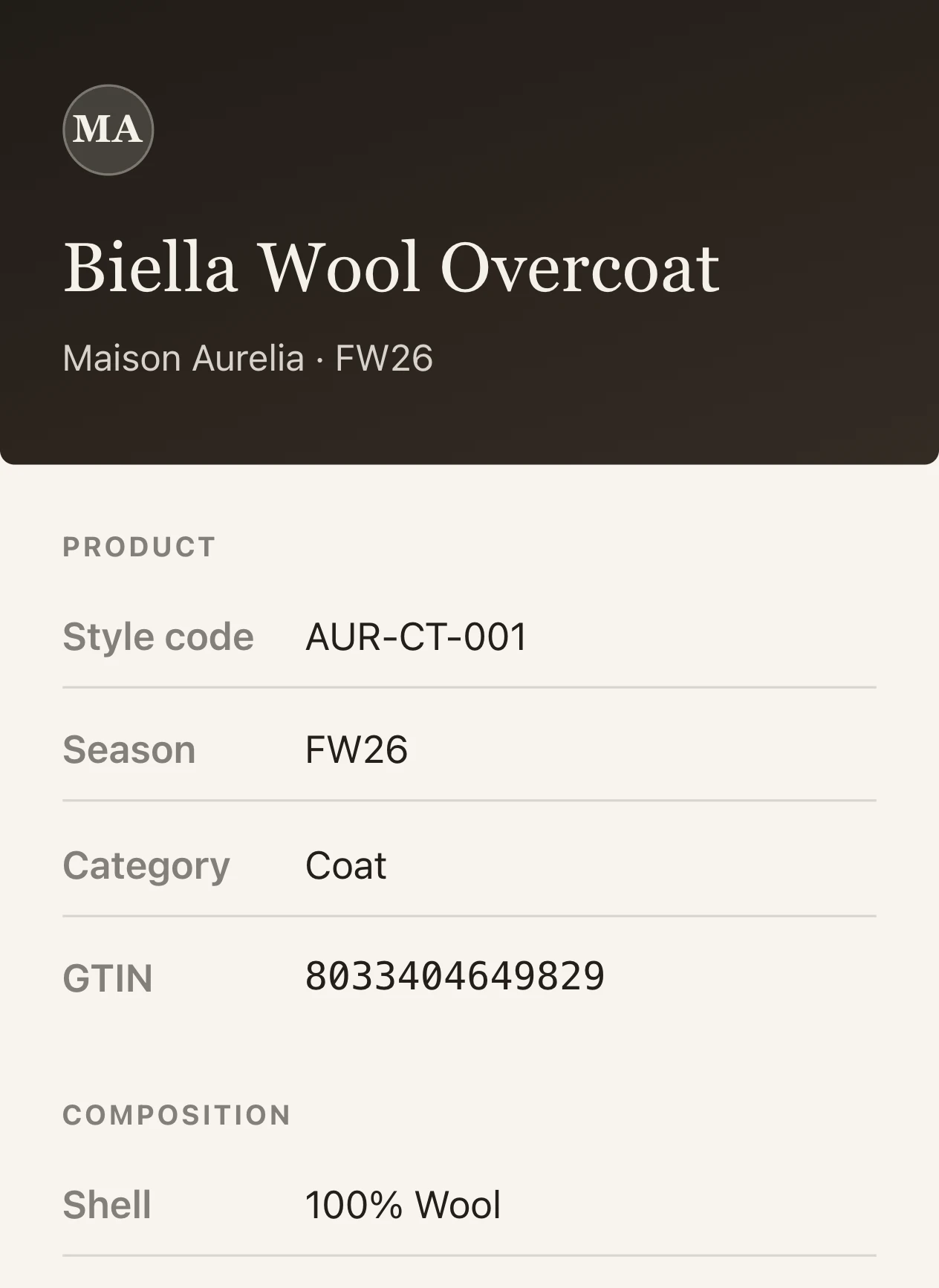
What anyone scanning the label seesPublic passport of a wool overcoat: product, composition, where it was made
The address, printed oncePublic address of a passport: QR code and permanent URL, marked live

Your suppliers answer in a single screen. Onboarding is immediate.

Subcontractors, CMT workshops and finishing houses receive one email and open one screen. It asks one thing at a time, in their own language, and shows from the start what you will see once they have sent it. They upload the documents they already have on file and can name their own suppliers in turn: that way the chain continues beyond them.

The supplier portal
One request, one screenSupplier request: declared values on the left, fields to complete on the right
not declared
The supplier declares their own suppliersSuppliers declared by a supplier, with tier and answer status
tier 2
Access

No two suppliers work alike

Spinners, dye houses and workshops keep their records each in their own way: on paper, in spreadsheets, in ageing management systems. Trama reaches every one of them where they already work, without asking for new tools.

Depth

Answering has to cost nothing

A supplier asked to adopt yet another tool stops replying. When answering takes minutes and installs nothing, response rates climb — and stay high.

Reuse

The data you need sits two tiers away

Your tier 1 knows its own suppliers; you often do not. With Trama each company in the chain brings in the next one, and visibility reaches the spinning mill and the fibre.

One code on the label. One address, for as long as the garment exists.

Composition, origin, certifications and care instructions reach the customer through the code printed on the product. It is printed once and keeps resolving to the current version; a correction never costs you a label reprint.

Public passport as seen on a phone
MAISON ROUX · MA-0041
QR code of a demo passport
Digital Product Passportid.tramaproof.com
Data carrierGS1
id.tramaproof.com/01/
08033404649829/10/W26
Labelnever reprinted
Brand domainsupported
Languagefrom the market
Behind a valueprovenance
Dyeing · ItalyTintoria Verona
Declared byLanificio Biella
DocumentDDT 4471.pdf
Confirmed byElena · 12 Aug

Brussels sets the deadlines. Readiness is built now.

Textiles, apparel and footwear are among the priority sectors under the ESPR regulation. That is exactly why Trama works on one industry and knows it thoroughly. Mapping a supply chain takes months: whoever starts today arrives ready rather than in a hurry.

2024

ESPR enters into force

Regulation (EU) 2024/1781 makes the Digital Product Passport a market-access requirement for products placed on the EU market.

July 2026

EU Registry goes live

The European infrastructure is operational and the first product groups are being registered. Textile is not among them yet — which is precisely the window in which to get your supply chain in order.

Upcoming

Textile delegated act

It will define the mandatory data requirements for apparel and footwear. Organizations with their supply chain already on board will only need to publish.

Horizon 2027–2028

First textile products fall in scope

The passport becomes a condition of access to the EU market. Supply-chain data collection can't be improvised once the deadline hits.

See where your supply chain stands, in six questions.

Answer six questions about one product. You get back a field-by-field view: what could be filled today, what could not, and which tier of the chain is holding the missing piece. Leave a work email and the result opens.

Six answers, and you know what you could publish today.

Describe your product.

1
2
3
4
5
6
Trama
Enter your work email

Privacy notice

58
Readiness

What you could publish today
Design Partner Program

A handful of partners. A structural head start.

We are selecting a small group of fashion brands and textile-district manufacturers for the launch phase: preferential terms for the first partners, a roadmap prioritised around your requirements, direct access to the product team — and the industry's reference case study when your supply chain is the first to be ESPR-ready.

Your details are used only to answer this enquiry. Privacy notice

EU hosting · GDPR compliant · Security controls aligned with ISO/IEC 27001 · Encryption in transit and at rest